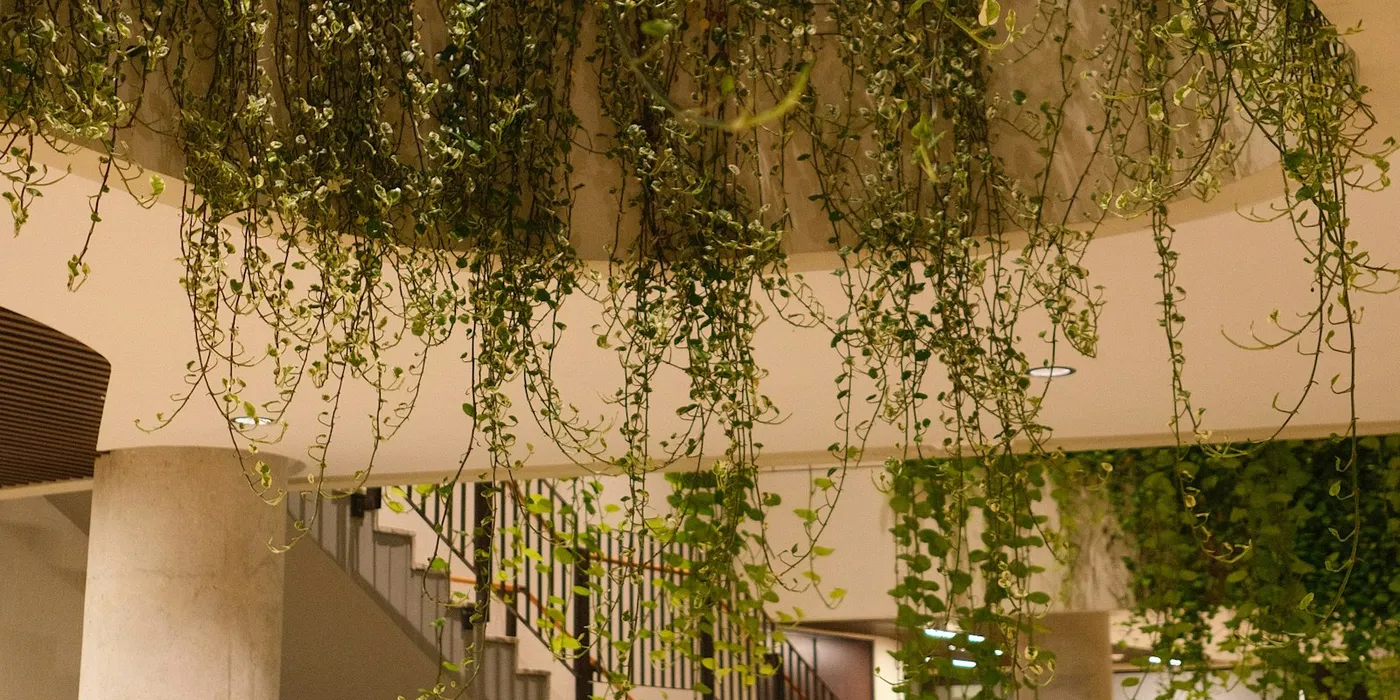
A well-built living wall does more than green a surface — it moderates humidity, filters particulates, and, at real scale, supports its own small insect and microbial community. The difference between a wall that thrives and one that gets ripped out in two years usually comes down to irrigation design, not plant selection.
Why so many living walls fail
Most failed installations aren’t a growing problem — they’re a plumbing problem. A living wall is effectively a vertical hydroponic system wearing foliage as a disguise, and it inherits every failure mode of one: uneven water distribution across the panel, root zones that dry out faster near the top than the bottom, and drainage that either pools at the base or never reaches it. Get the irrigation loop wrong and no amount of plant selection saves the install.
A living wall is a vertical hydroponic system wearing foliage as a disguise.
What a self-tending wall actually needs
The systems that hold up over years share a few unglamorous traits: a recirculating reservoir sized generously enough that it doesn’t need daily top-offs, drip emitters placed at every panel rather than relying on gravity to spread water sideways, and a felt or modular tray substrate that holds moisture evenly instead of channeling it. Plant selection still matters — ferns and pothos forgive inconsistency far better than flowering species — but it’s the second decision, not the first.
The ecosystem part is real
Once a wall has been running for a season or two, it does start to behave like a small habitat rather than an installation: springtails and other detritivores show up in the substrate, humidity-loving plants colonize the shadier lower panels on their own, and the wall’s water chemistry settles into something closer to a pond than a planter. That’s the point at which a living wall stops needing to be managed and starts needing to be maintained — a meaningfully lower bar.