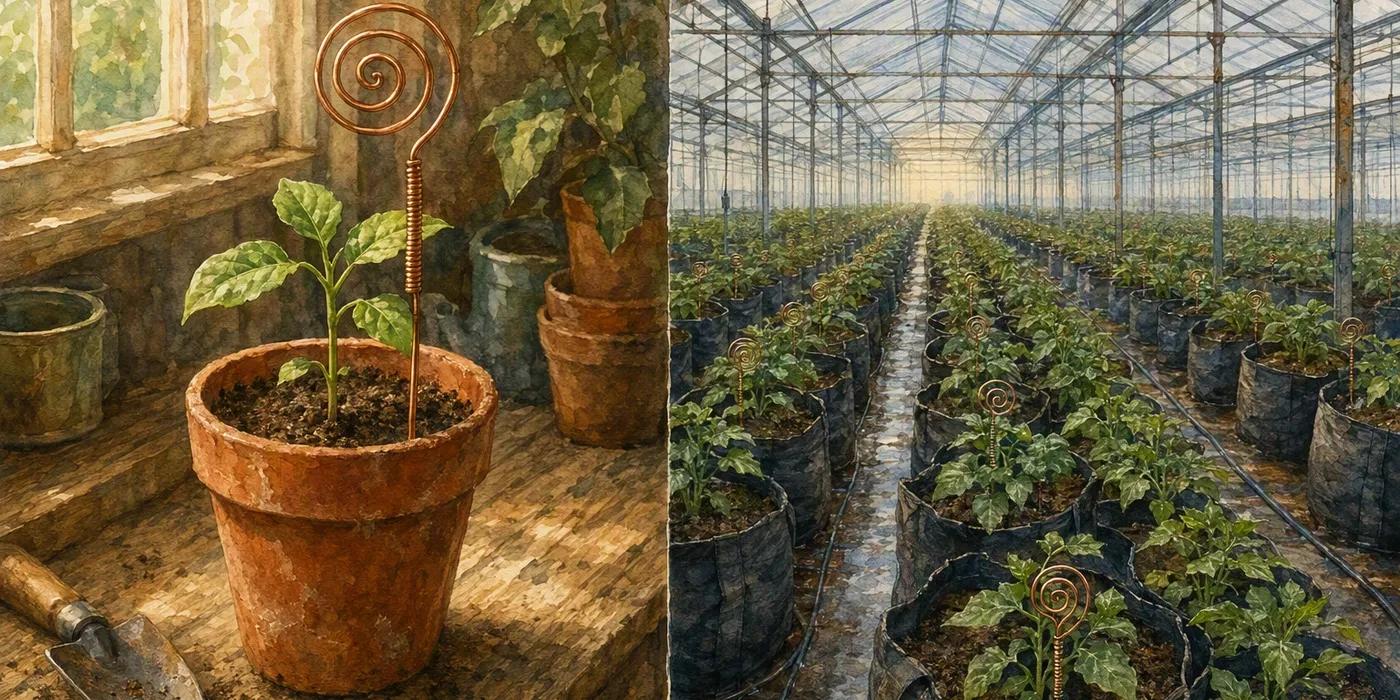
I got the idea for this piece standing in a Starbucks line, of all places.
There was a photograph on the wall of one of their supplier greenhouses: rows of fabric grow bags stretching back farther than the frame could hold, each one full and green.
My first thought wasn’t about coffee. It was: how would you even wire that for electroculture? A spiral antenna in every bag? Someone would spend a career doing nothing else.
That question stuck with me because it exposes a problem that gets surprisingly little attention in electroculture discussions: scale changes the problem. A technique that makes perfect sense for one plant may become inefficient when you have a hundred plants, impractical when you have a thousand, and completely inappropriate when you’re working around tractors and other agricultural equipment.
This isn’t unique to electroculture. Whenever we introduce a physical or environmental stimulus into a living system, we have to consider not just what the technology does, but what system we’re introducing it into, how large that system is, what it interacts with, and how we will know whether it made a difference.
One note before going further: this article isn’t about whether electroculture works. That question is still contested, and we grade it that way — see the electromagnetic environment of the garden for where the evidence stands. This is about a different question: if you want to try it, how do you fit the method to the system?
Scale changes the intervention
It’s tempting to think of scale as simply making the same system bigger. If one plant needs one device, perhaps 100 plants need 100 devices.
But biological systems don’t necessarily scale linearly. As a growing system gets larger, new variables appear:
- spatial variation
- environmental gradients
- labor
- maintenance
- infrastructure
- equipment compatibility
- safety
- energy requirements
- monitoring
- cost
- experimental design
The biological target changes, too. At the smallest scale, you might be trying to influence an individual plant or its root zone. At larger scales, you may be influencing a crop row, a greenhouse zone, a field, or the physical environment surrounding an entire growing operation.
So before asking “Which electroculture device should I use?”, there is a more fundamental question:
What is the biological system I’m actually trying to influence?
That question turns out to matter at every scale.
Five questions to ask before choosing a stimulation method
A useful way to approach any environmental stimulation technology is to start with the system rather than the device.
1. What is the biological target?
Are you trying to influence a seed? An individual plant? The root zone? A group of plants, a crop row, the soil environment, a greenhouse, an entire growing area?
The answer determines what “localized” means. A field-scale intervention doesn’t need to treat every plant individually if the intended target is an environmental condition shared by the crop.
2. What is the spatial scale?
A field isn’t simply a very large garden. Larger systems introduce spatial variation: differences in soil, moisture, topography, exposure, plant density, airflow and other environmental conditions. An intervention that is reasonably uniform around one pot may be highly non-uniform across an acre.
That doesn’t necessarily make it ineffective. It means distribution becomes part of the design problem.
3. How controllable is the intervention?
Can you control intensity, duration, timing, frequency, location, and spatial distribution?
A passive atmospheric collector and an actively controlled electrical system are very different kinds of experimental systems, even if both are casually described as “electroculture.” The more complicated the growing environment becomes, the more important controllability can become.
4. What else does the intervention interact with?
A stimulation system doesn’t exist in isolation. It may interact with:
soil or growing media → water → atmosphere → plants → electrical infrastructure → machinery → people
Those interactions can become especially important in hydroponic, aeroponic and greenhouse systems, where the growing environment itself is highly engineered.
5. How will you know whether it worked?
This question is easy to overlook. At the scale of one plant, you may simply observe differences between a treated plant and an untreated one. At larger scales, things get harder.
If one section of a field produces more, was it the stimulation — or did that section have better soil, different irrigation, more sunlight or a different planting history? As systems grow, measurement and experimental design have to scale along with the intervention.
Houseplants and tiny gardens: where localization makes sense
A single pot, or a small cluster of pots on a balcony, is where individual stimulation methods make the most intuitive sense.
A spiral antenna placed near one plant can provide a localized intervention without requiring much infrastructure. The labor cost is minimal. Installation is simple. And if something doesn’t work, you’ve lost an afternoon rather than an entire growing season.
There is another advantage at this scale: the plant can be the unit of the experiment. You can compare one treatment with another, vary antenna geometry, or maintain an untreated control. That makes small-scale growing environments particularly useful for exploration.
The goal isn’t necessarily to find the one perfect configuration. It is to learn what variables appear to matter. At this scale, a simple antenna can be both a stimulation device and an experimental tool.
Small gardens: from individual plants to coverage
Once you move from a few pots to a real garden bed, the design problem begins to change. You may still be interested in individual plants, but treating every plant separately becomes less attractive.
Instead of asking “How do I stimulate this tomato?” you can begin asking “How do I create the desired environment across this bed?”
That opens up different possibilities. A single structure might influence several plants. Linear arrangements can follow a row. Distributed systems can cover an area rather than a single point.
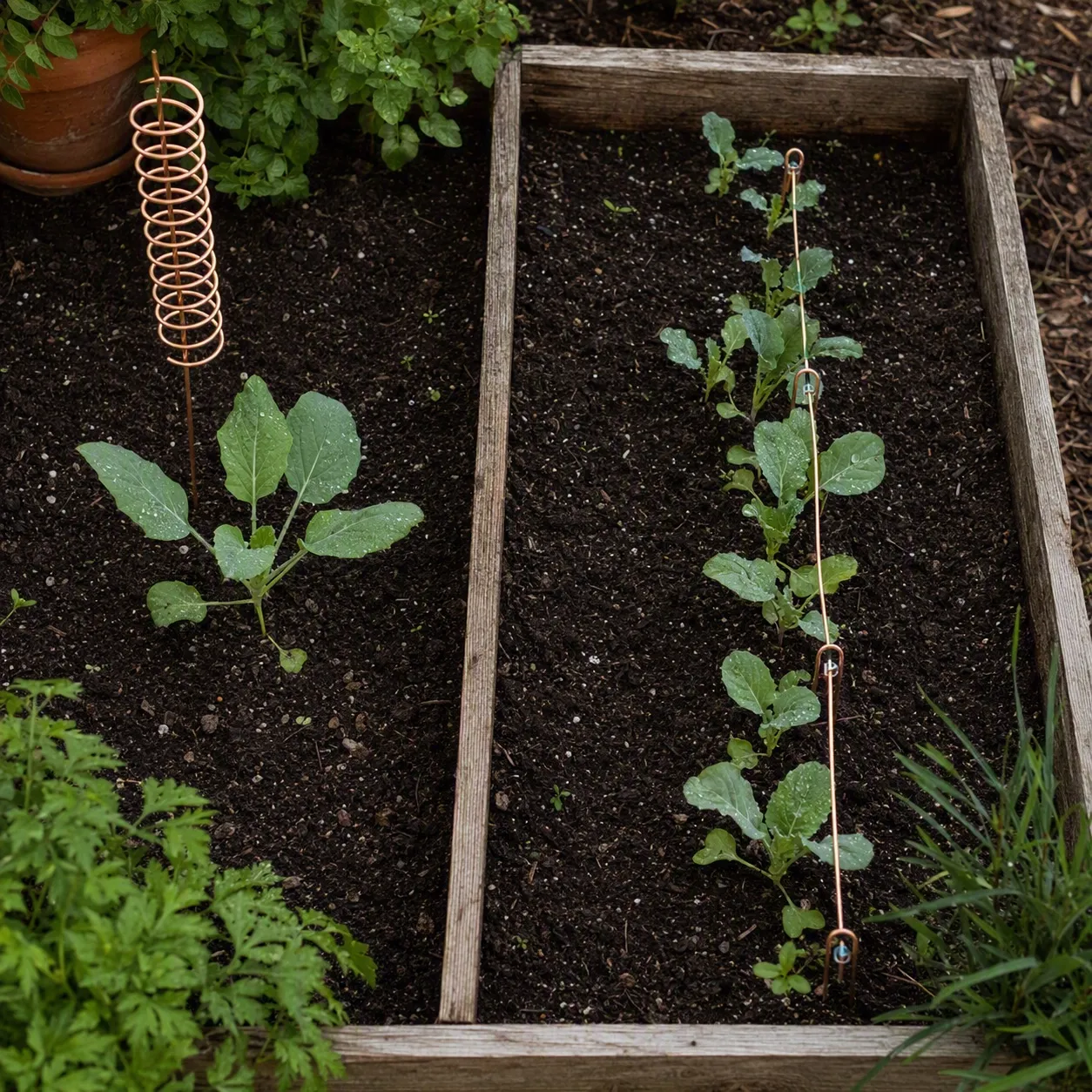
An individual antenna (left) and a distributed line arrangement (right) aren’t competing answers. They’re solutions to different spatial problems.
This is also a particularly interesting scale for experimentation. You can divide a garden into treatment and control areas, or compare different stimulation approaches while keeping many of the other growing conditions similar. In other words, the garden can become a small experimental system.
Indoor growing: more control, more coupling
Indoor growing environments change the equation again. An indoor bed, greenhouse bench, or other controlled growing environment may have less exposure to weather, but it also contains more engineered infrastructure. Lighting, irrigation, nutrient delivery, ventilation, environmental controls and electrical systems may all be operating in the same physical space.
That can make environmental stimulation easier to control in some respects — and more complicated in others. The important question becomes less about waterproofing and more about integration:
- Where does the stimulation system physically live?
- How does it interact with irrigation?
- Does it interfere with sensors?
- Does it interact with other electrical equipment?
- Can it be maintained without disrupting production?
A growing system may be biologically complex even when the physical environment appears highly controlled.
Greenhouse scale: when stimulation becomes infrastructure
Back to that Starbucks photograph. A commercial greenhouse containing hundreds or thousands of grow bags cannot reasonably be treated like a collection of backyard plants. Even if individual installation took only ten seconds per plant, the labor adds up quickly.
And installation is only the beginning. There is maintenance. There are failures. There are damaged components. There are changes to crop layout. There are workers who didn’t install the system and may not know what it is.
At some point, the question stops being “Which antenna should I put next to each plant?” and becomes “Should this be an antenna system at all?”
That’s a fundamentally different engineering question. Instead of individual devices, you might begin thinking about infrastructure integrated into the growing environment: distributed conductors, zone-level systems, conductive structures, controlled field generation, or other approaches that can address an area rather than an individual plant.
The important point isn’t that one of these approaches is automatically better. It’s that the architecture of the solution has changed. The stimulation system is becoming part of the greenhouse itself.
Medium gardens and small farms: scale introduces operational risk
Medium plots and small farms introduce another category of constraint that has little to do with plant biology: machinery. Anything installed in or near the soil eventually has to coexist with the equipment used to work that soil.
I learned this one the hard way. Years ago, I hit a wire in my own garden that I’d installed for an experiment and completely forgotten about. My tiller caught it. The machine ended up at the repair shop.
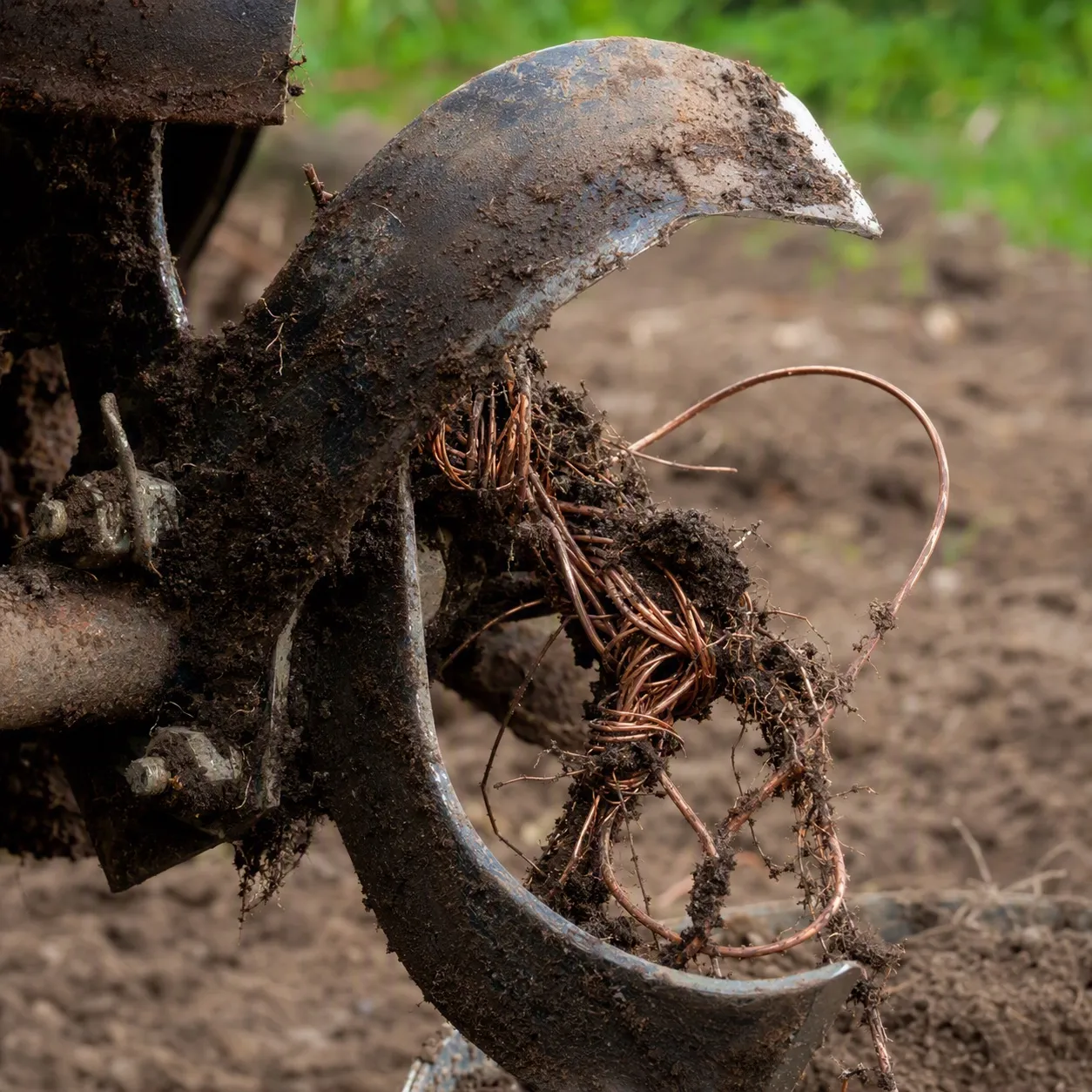
An AI-generated illustration of the moment a forgotten buried wire meets a tiller — not a photograph of the actual incident.
For a small consumer tiller, that’s an annoyance and an unexpected bill. Now imagine the same design on a farm. A buried conductor that gets caught by a tractor, tiller, cultivator or subsoiler isn’t merely inconvenient. It can become an equipment-damage and safety issue.
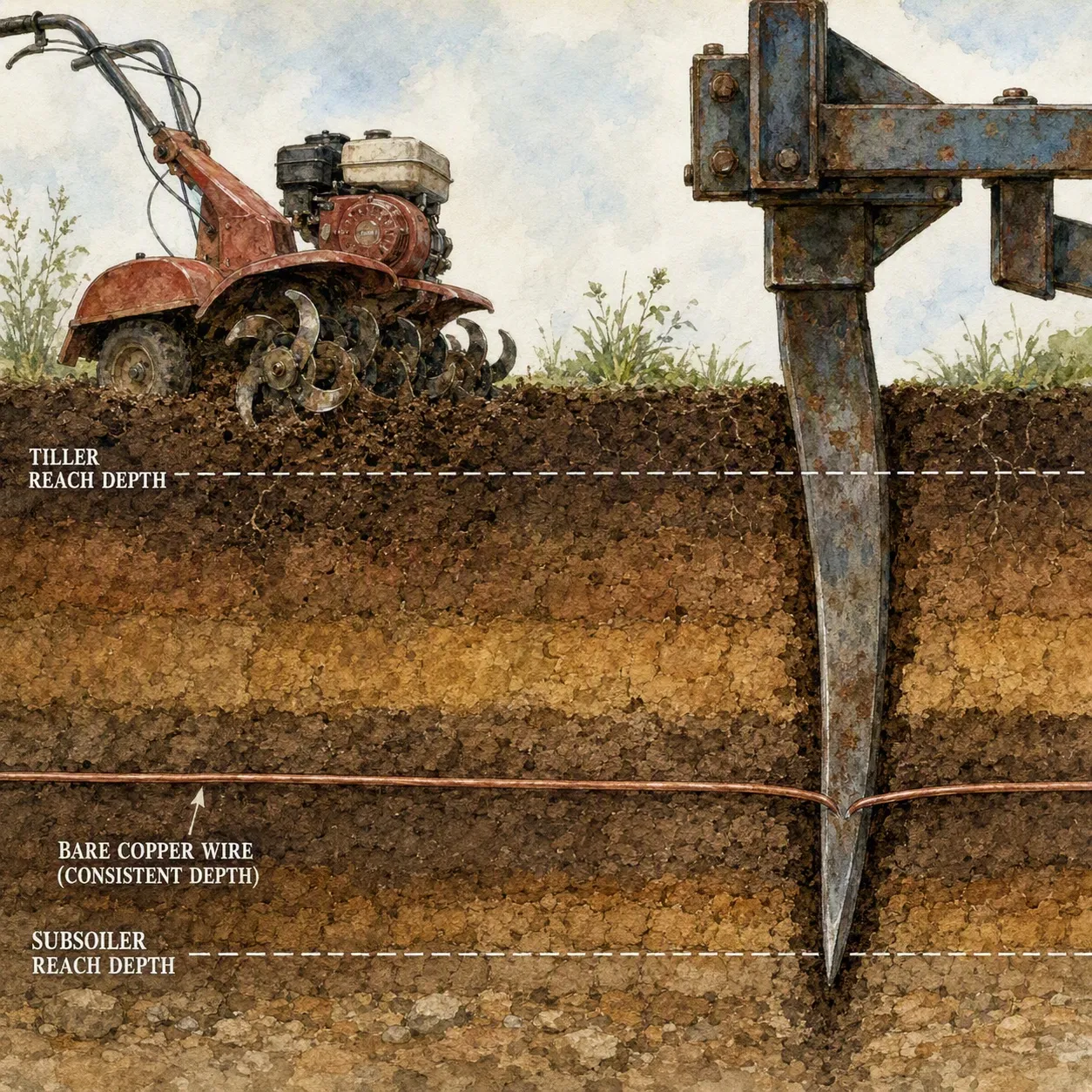
A garden tiller and a farm implement reach very different depths. The same buried wire that catches a tiller might sit well clear of it — and still land squarely in a subsoiler’s path.
And there is another problem: people forget. The person who installed an experimental system may not be the person operating the farm five years later. A buried component may outlive the memory of why it was installed.
That means farm-scale environmental technology has to consider more than whether the intervention can produce a biological effect. It has to consider the system’s entire lifecycle:
installation → operation → maintenance → modification → equipment interaction → eventual removal
At this scale, documentation and mapping aren’t administrative details. They’re part of the design. Surface-mounted or removable components, clearly documented installation locations, appropriate separation from machinery, and designs that fail safely can become much more important as the physical and economic scale increases.
Controlled-environment agriculture: the growing medium changes the system
Hydroponics, aeroponics and other controlled-environment systems introduce another interesting problem: the growing medium isn’t necessarily soil.
Water conductivity, nutrient concentration, pH, flow rates, electrode placement, misting cycles, pumps and reservoirs can all become part of the electrical environment. That means an electrical intervention can no longer be considered independently from the medium carrying it. A small change in electrode location, for example, could expose very different portions of a system to the stimulus.
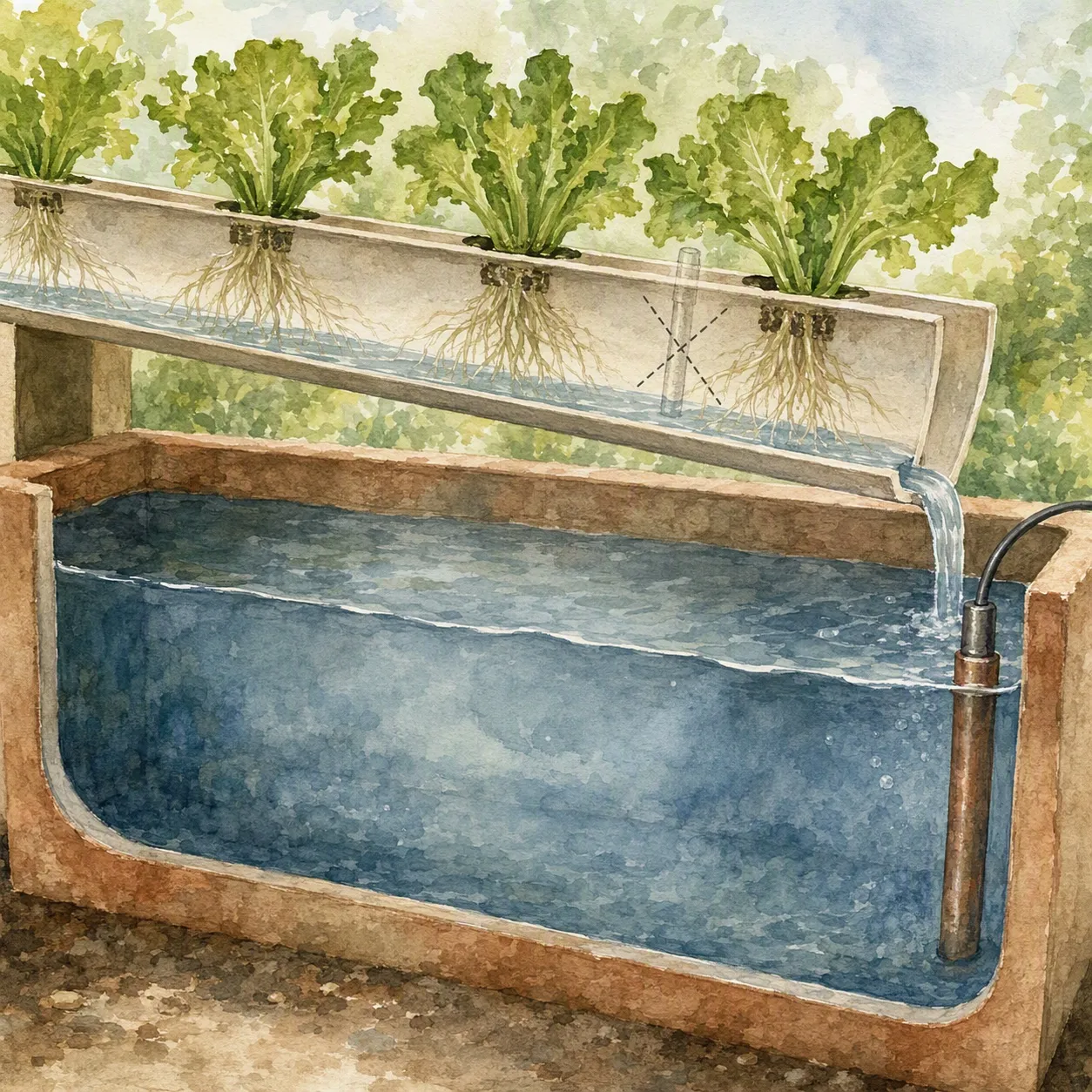
A growing channel feeds a nutrient reservoir below it. Where an electrode sits can matter: the reservoir, the channel, and the root environment are not necessarily equivalent electrical environments.
This is a good example of why scale isn’t the only variable. Two systems occupying the same physical area can present completely different engineering problems because their internal structure is different. A soil bed, a nutrient film, an aeroponic root chamber and a field crop may all contain plants, but the pathways through which a physical stimulus interacts with those plants can be radically different.
The bigger picture: environmental stimulation is a systems problem
At this point, electroculture starts to look like an example of a much larger category of design problems. We can influence living systems through many aspects of their physical environment. Depending on the technology and the question being investigated, those might include:
- electrical fields or currents
- magnetic fields
- electromagnetic exposure
- light
- sound or vibration
- temperature
- humidity
- atmospheric conditions
- mechanical stimulation
- other physical environmental variables
These technologies aren’t interchangeable, and mentioning them together doesn’t imply that they have the same biological effects. The common thread is something else: they all become part of the environment of the living system. And once they become part of that environment, they interact with everything else.
The intervention is part of the system
This is perhaps the most important lesson. Your stimulation setup was never just the antenna, electrode, coil, controller or other device. It is connected to the system around it.
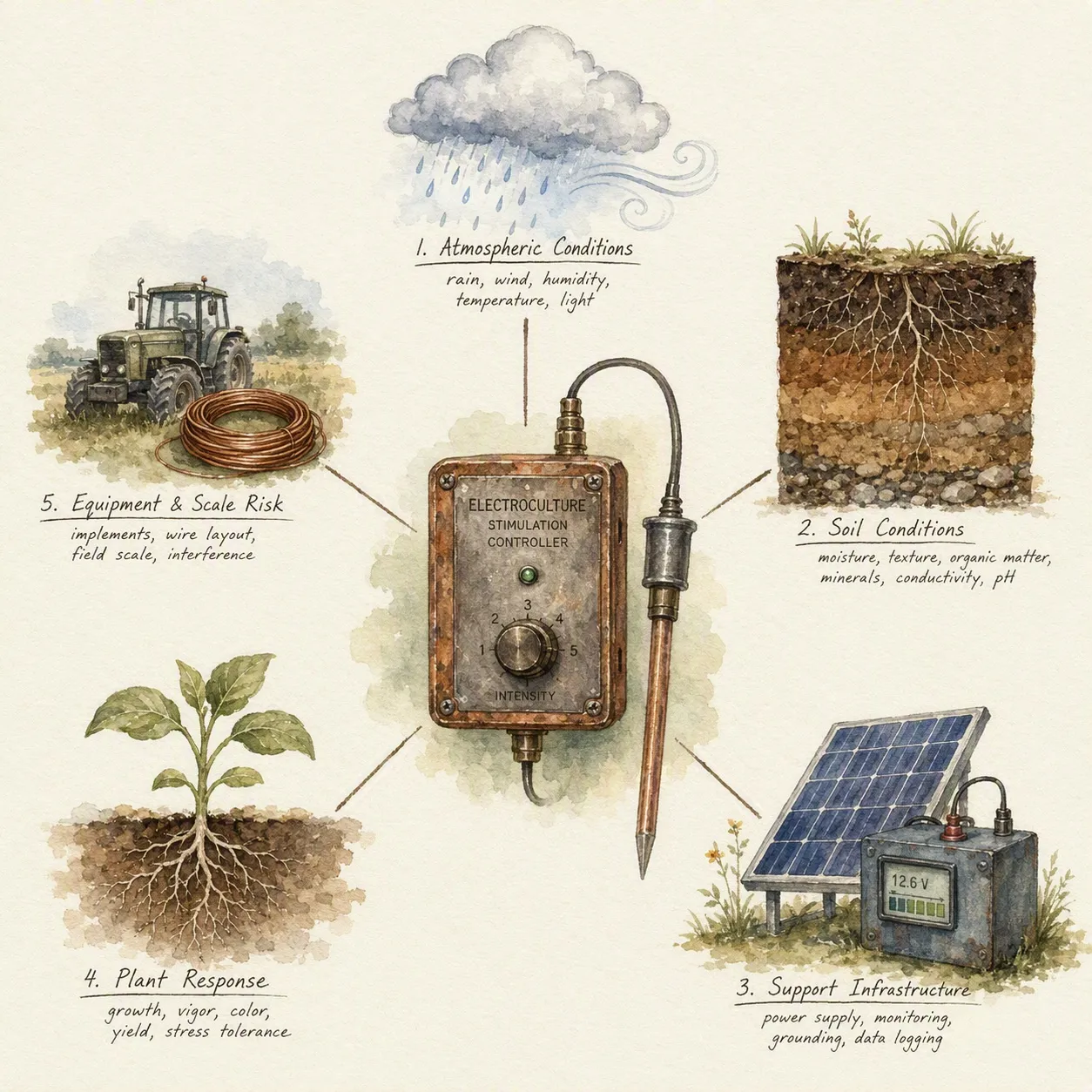
The stimulation device sits at the center of a web of interactions: weather, soil, power and monitoring, the plant itself, and the equipment and scale of the operation.
The connections don’t disappear as the system grows. Their relative importance changes. A backyard gardener may be primarily concerned with plant response, soil conditions and ease of experimentation. A greenhouse operator may be more concerned with integration, uniformity, monitoring and maintenance. A farm operator may be more concerned with machinery, labor, lifecycle management, safety and economics.
The system has the same basic categories of interaction, but different constraints dominate the design. That is what makes scaling a biological intervention so interesting.
Bigger doesn’t necessarily mean stronger
There is another assumption worth challenging. Scaling an intervention does not necessarily mean increasing its intensity.
- Sometimes scaling means increasing coverage.
- Sometimes it means increasing uniformity.
- Sometimes it means making the intervention more controllable.
- Sometimes it means changing from individual treatment to environmental modification.
- And sometimes the correct answer is to abandon a particular technique altogether.
A method that is useful at small scale may simply have no sensible path to larger scale. That isn’t necessarily a failure of the method. It may be a failure of scale matching.
Scale also changes what counts as a good experiment
There is a final connection between scale and evidence that is easy to miss. At small scale, you can often change one variable at a time. At larger scale, the number of interacting variables increases, which makes it more difficult to attribute an observed result to a particular intervention.
Suppose a treated section of greenhouse produces better growth. Was the stimulation responsible? Or did that section receive slightly more light? Was irrigation more uniform? Was the substrate different? Did the plants happen to be healthier when they were transplanted? At field scale, the questions become even more difficult.
This is why scaling an intervention and scaling the experiment are inseparable problems. The larger the system becomes, the more valuable it becomes to know:
- what the treatment actually was
- where it was applied
- when it was applied
- what the control was
- what environmental conditions changed
- what outcomes were measured
You don’t need a laboratory to start thinking this way. Even a garden can be designed as an experiment. But the larger the system, the more important experimental design becomes.
So where does this leave electroculture?
None of this means electroculture necessarily gets harder as you scale. It means the appropriate approach can change.
A spiral antenna that makes sense beside a kitchen windowsill plant may not make sense across a quarter-acre plot. A field-generation approach designed for a commercial greenhouse would be ridiculous overkill for a single tomato plant. And an installation that looks technically elegant on paper may be a poor agricultural design if it creates maintenance problems, interferes with machinery, or cannot be documented for the next person who operates the property.
The first question shouldn’t be “Which electroculture device should I use?” It should be:
What system am I trying to influence, at what scale, under what constraints?
Then you can ask what kind of stimulation, if any, makes sense.
That’s a principle that extends well beyond electroculture. Whenever we’re trying to influence a living system through its physical environment, the intervention has to fit not only the biology, but also the spatial scale, infrastructure, operating environment, human constraints and feedback loops of the system we’re introducing it into.
The goal isn’t to find one technology that works everywhere. It’s to find the right intervention for the system you’re actually trying to change.